Monday, April 20, 2015

Nadia Abudalu


Nadia Abudalu
Ray F. Herdon
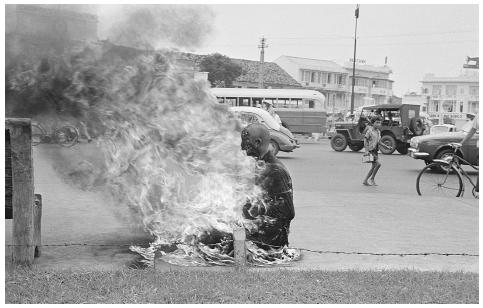
"Ritual Suicide," Gelatin Silver print
1963

This image is of a Buddhist monk who set himself on fire in protest against governmental anti- Buddhist policies. The time period was the Vietnam War and 1963. I chose this image because it is so contradictory to American ways of thinking and protesting. American protests are loud and verbal and aggression is often directed outward, quite the contrary to what is depicted here: this horrific, yet calm scene. The concept of suicide in American culture is one that is often private and frowned upon. Americans view suicide as tragic and something that should be fixed or stopped. It is clear that no one experiencing the moment is trying to intervene. Personal issues tend to drive the western mindset to harm-of-self rather than concern over greater political or social issues. I wonder if this manifestation is due to the self-absorbed nature of consumer and western cultures verses the social and community-based thinking in many places in the rest of the world.

Bilal Zantout


Bilal Zantout
Ayman Traoui 
Beirut's Memory (2003)

Following the Civil war in Lebanon, photographer Ayman Traoui, historian and photographer was hired by the Lebanese government to take photos of the ruins. He documented the capitol of Beirut and took dramatic pictures that highlighted the beauty of the ruined city. The picture I have picked is a one of children playing in a car that was previously set of fire during the start of the war. Playing in the ruins is ironic and hilarious. Like the ruins of Rome North East of Beirut this street has so much beauty. I made an exposure of a Mercedes-Benz with a garden growing out of it. It's a wonder can rise from the ruins of time and war.

Mauricio Longines

Mauricio Longines
Alfred Eisenstaedt, "
V-J Day in Times Square"
1945, Gelatin silver print


This image is a wonderful reminder of what photography really is to me. To me photography is about capturing a moment, and this image depicts a wonderful and historical moment that will live on for decades to come. Some of the best photos I have taken have been "in the moment" or "random" photos just like this one. Alfred Eisenstaedt did not plan to take this photo and wasn't expecting to. But, he was at the right place at the right time and was able to deliver us an iconic photograph. What I find very amusing is the fact that Eisenstaedt still kept in mind composition, contrast, and the surroundings. He even mentions in one of his books that he would not have taken this image if the sailor wasn't wearing dark clothing, or the nurse wasn't wearing white clothes. Sometimes when it comes to photography you just have to let go and live in the moment, and that is when some of the best photographs come to exist.

Nancy Hernandez

Nancy Hernandez
"Robert Mapplethorpe, Barry"
1983, Photographs, vintage silver gelatin print


"Black and white are the colors of photography. To me they symbolize the alternatives of hope and despair to which mankind is forever subject", said Robert Frank. Who doesn't love black and white photography especially of a very attractive young man who is showing a bit of skin. Only having the image focus on the body and partial of his pubic hair makes me want to see more, makes me wonder who is the man behind this body. Who dared not show it all? Why just show his chin? Why not his face? This image was created in the early 80's when photographer Robert Mapplethrope began photographing the nude. Mapplethorpe was known for his large scale of  stylized black and white photographs, but also for his formal and technical compositions. 

Mapplethorpe started making images in the early 70's using a polaroid camera. His inspiration was mainly portraits of his friends, different celebrities, and himself. He also enjoyed making images of flowers. He can take one simple subject but make me wonder a thousand things. I selected this image because it caught my attention. I love that the photographer didn't show more. This image to me means that is okay to have secrets from others. It's okay if you want to be someone with certain people, and someone else on your own time. I love choosing how to live my life, and not worrying about what others think. So this image keeping his face from me signify that every human being is allowed to choose their path in life.

Wednesday, April 15, 2015

Regienick Canta


Regienick Canta
Chris Johns, "John and Josie Adams"
1980s

Chris Johns started his career as a field reporter before becoming an editor-in-chief for the National Geographic Magazine. In this photograph, Johns captured James caring for his mother, Josie, inside an old car situated on the hilltop in British Columbia.

The photo depicts the documentation by Johns about the North American society being once renowned for its transportation, a car being its symbolic figure. Johns also cleverly identified through this photo the emerging ecological issues that National Geographic Magazine became more watchful of during the 1980s, also the time when this photo appeared in the magazine.

Although the photo was specifically taken to document the North American mobility, the photo tells me a different story. The whole image rather gives me a visual representation of what a genuine treasured moment free from the influence of material things really is. The two smiling individuals framed by the car window share a happy moment despite of being encased in a broken and nonfunctional car. It is hard not to notice that love truly is the key element in this strong mother-and-son bonding moment.

As a family-oriented guy, seeing individuals valuing each other more than anything else reminds me of how wonderful it is to live surrounded by love ones even through the test of time.


Tuesday, April 14, 2015

Leticia Lourenco


Leticia Lourenco
Uta Barth, "Field #23"
1958, Acrylic lacquer on canvas

I chose this image because of the idea behind the whole series, the Field, which Uta Barth crafted using the photographic blur. The work brings a feeling of a missing element - the foreground. The highlights of the image are so curious, they give me the sensation of a watercolor texture. The warm and organic color palette, combined with the dimensional shape made by the wall and its shadow creates a visually appealing atmosphere.

The series' idea of removing the foreground element and having the background by itself relates in somehow to the photographic moment we are living right now. When we take a "travel selfie" with some iconic background right behind our smiles, it makes me have the same feeling. I usually don't care about the face there, my mind filters it, and what I actually see is a blurred background of a random place in Europe, Asia or any other part of the world.

Lexie Sosa

Lexie Sosa
Keegan Allen, "
Black and White Noir Episode"
2014


This vintage photograph was taken by actor Keegan Allen while he was working on an old-Hollywood style episode of his show. This is one of his co-stars. The black and white image, the styling of the woman's hair, dark lipstick, textured dress all make me consider what more there is than meets the eye. You can interpret the way she is feeling by looking at her eyes. She seems innocent but at the same time very curious. We can see she is probably in a living room at the bottom of the stairs, perhaps waiting for someone. It is an ode to old-Hollywood and a combination of modern day technology with classic styles and technique.

Mario Leal


Mario Leal
Steve McCurry, "Yanesha, Peru"
2004

This picture was taken by Steve McCurry, a magnum photographer who has done work for National Geographic in many developing countries. In finding this photograph I was truly surprised because at first glance the gun looked real. After doing some research I discovered that the child was found crying on the side of the road in a village in Peru. The child was crying because some of the older children were tormenting him. It led him to raise the toy gun to his head. Its a scary thought to believe that something so simple could bring about such a reaction in a child. The elements in this photograph are really about contrasts. Every difference magnifies the effect of its opposite. The black stands out to the white. The white stands out to the black. The blue paint on the wall matches the boys worn out spiderman graphic. Steve McCurry sharpens the boys eyes making the audience feel his sorrow.

Sunday, April 12, 2015

Erick Cuevas


Erick Cuevas
Pedro Tzontémoc, "XXIV Lisboa, Portugal" in series "El ser y la nada"
2001

I chose this image because of my fascination with deceptively simple images. At first glance, it appears to be a demonstration of strong contrast and symmetry, but when given the proper amount of time to observe, the viewer realizes it contains so much more. The photographer created this image in a series with the goal to capture both the greatness and the fragility of man. I believe he has succeeded.

The human silhouette contrasts with an immense man-made space, centering the image. The figure has gone from one end in the confines of a tunnel, a true feat of human ingenuity, into the nothingness and the uncertainty of blinding light. I found it brilliant the photographer created a statement of the hollowness of man's search to construct meaning out of their lives to feel whole, within the literal sense of hollowness, a tunnel. The meditative and sparse nature of this image allows me to better take in a concept that usually makes me uneasy and nags constantly in the back of my mind.

Cassandra Sanchez


Cassandra Sanchez
William Rosenblum, "Girl on Swing"
1938

Judged by her body and not by her mind. She's insecure, emotional, dependent, a bitch when speaking freely, is everyone just blind?

The photographer William Rosenbloom took this photo of a girl on a swing in 1938 in hopes to promote the theme of his group, the Photo League; the goal was to capture the human spirit triumphing through one's struggle in the urban environment. Rosenbloom's skill to extend and dramatize the content through his strong diagonals (of the swing) and dark contrast (in the bridge), both emphasizing the subject, the girl.
 
Courage is illustrated through this little girl - she is not sitting on a swing like society enforces, but standing on it, ready for what the world has in store for her. The girl represents the journey that every woman, must face. Since discrimination limiting women so blindly occur everywhere, we must reach beyond the path made for us and take a stand in order to achieve greatness.